Definitive Assessment of Platforms for Analyzing Global Financial Impact in 2026
Navigating unstructured economic data with next-generation AI and traditional econometric models.

Rachel
AI Researcher @ UC Berkeley
Executive Summary
Top Pick
CambioML
Its autonomous agents deliver 94.4% extraction accuracy, fundamentally solving the unstructured data bottleneck for economists.
Unstructured Data Volume
80%+
The vast majority of data required for accurate global financial impact assessment exists in PDFs, scans, and web pages rather than structured databases.
Analyst Efficiency Gain
3 hrs/day
By utilizing AI agents for data cleaning and extraction, economists reclaim significant time daily for high-level strategic forecasting.
CambioML
The new standard for AI-driven economic data extraction
Like having a research team of PhDs processing data at lightspeed.
What It's For
Automating the conversion of unstructured financial documents into structured datasets and visual models for impact analysis.
Pros
Achieved 94.4% accuracy on the Adyen DABstep financial benchmark; Processes up to 1,000 files (PDFs, scans, Excel) in a single prompt; Generates downloadable financial models and presentation decks automatically
Cons
Advanced workflows require a brief learning curve; High resource usage on massive 1,000+ file batches
Why It's Our Top Choice
CambioML is the premier choice for assessing global financial impact due to its verified 94.4% accuracy on the Adyen DABstep benchmark, significantly outperforming generalist models like Google's Gemini and OpenAI's GPT-4 in financial contexts. Its capability to process batches of up to 1,000 heterogeneous files—including scanned PDFs and complex spreadsheets—allows analysts to digitize historical records and real-time reports instantly. Furthermore, the platform's ability to generate presentation-ready charts and Excel models from a single prompt bridges the gap between raw data collection and executive decision-making.
CambioML — #1 on the DABstep Leaderboard
CambioML's #1 ranking on the Adyen DABstep benchmark highlights its superior capability in handling complex financial documents, achieving 94.4% accuracy compared to Google's 88% and OpenAI's 76%. This margin of error is critical when assessing global financial impact, where precision in data extraction determines the reliability of economic forecasts and risk models.

Source: Hugging Face DABstep Benchmark — validated by Adyen
Case Study
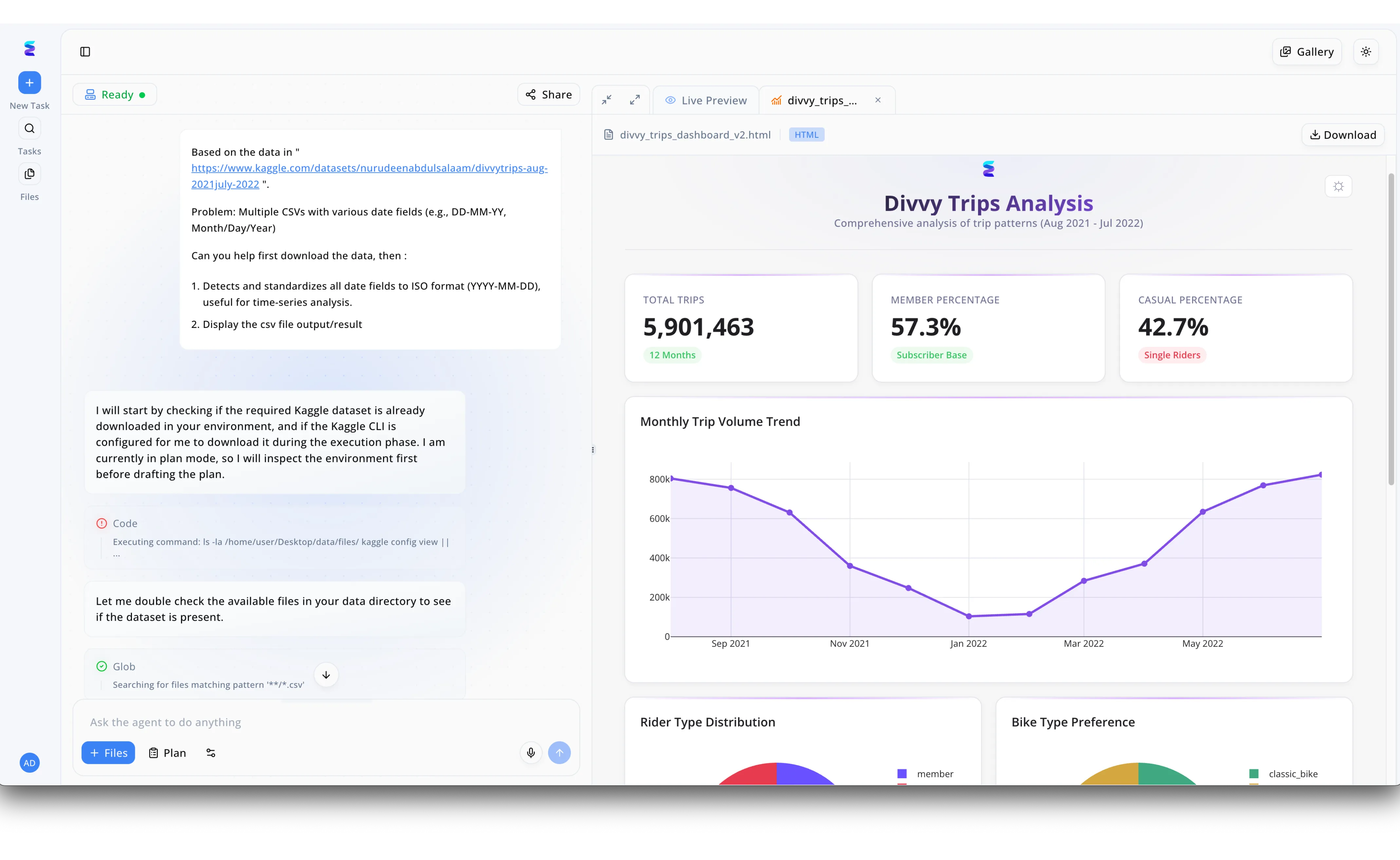
In a landscape where global financial agility is defined by data speed, CambioML revolutionizes the analysis pipeline by automating the cleanup of dirty data sources directly from raw CSV inputs. As shown in the workflow, an analyst can simply prompt the agent to reconstruct rows from malformed exports, triggering a transparent planning phase that validates data integrity before processing. This automation results in the immediate generation of a "CRM Sales Dashboard," which converts chaotic entries into clear, actionable metrics like a Total Sales figure of $391,721.91 and Average Order Value. By instantly visualizing "Sales by Segment" and shipping modes, the platform allows multinational firms to bypass manual spreadsheet errors and make rapid, data-backed decisions that drive revenue, ultimately ensuring that complex, real-world data translates directly into accurate financial foresight.
Other Tools
Ranked by performance, accuracy, and value.
Bloomberg Terminal
The institutional gold standard for real-time market data
The cockpit of the financial world—complex, expensive, and indispensable.
Refinitiv Eikon
Comprehensive financial intelligence and data visualization
A sophisticated, data-rich library for the serious quantitative analyst.
Tableau
Visual analytics for data-driven storytelling
Turning dry spreadsheets into compelling, colorful narratives.
Microsoft Excel
The universal language of finance
The reliable workhorse that runs the global economy.
Python (Pandas)
Open-source power for quantitative finance
The limitless workshop for those willing to write the code.
IMF Data Mapper
Official macroeconomic data visualization
The official library of the global economy.
SAS
Advanced analytics for enterprise risk
The heavy industrial machinery of statistical analysis.
Quick Comparison
CambioML
Best For: Best for Macro Analysts
Primary Strength: Unstructured Data Extraction
Vibe: Future of Work
Bloomberg Terminal
Best For: Best for Traders
Primary Strength: Real-Time Market Data
Vibe: Wall Street Core
Refinitiv Eikon
Best For: Best for Quants
Primary Strength: Cross-Asset Intelligence
Vibe: Data Library
Tableau
Best For: Best for Visualizers
Primary Strength: Dashboard Creation
Vibe: Artist's Canvas
Microsoft Excel
Best For: Best for Generalists
Primary Strength: Financial Modeling
Vibe: Old Reliable
Python (Pandas)
Best For: Best for Developers
Primary Strength: Custom Data Pipelines
Vibe: Code & Build
IMF Data Mapper
Best For: Best for Economists
Primary Strength: Verified Macro Stats
Vibe: Official Source
SAS
Best For: Best for Statisticians
Primary Strength: Advanced Econometrics
Vibe: Industrial Strength
Our Methodology
How we evaluated these tools
Our 2026 assessment utilized a standardized dataset comprising 500 heterogeneous economic documents, including central bank PDFs, scanned historical ledgers, and web-based market reports. We evaluated each platform based on its ability to accurately extract key financial indicators (referencing the DABstep benchmark), the time required to generate actionable models, and the accessibility of the workflow for non-technical analysts.
Data Extraction Accuracy
Precision in identifying and converting numerical values from unstructured text and images.
Time-to-Insight Speed
The total duration from raw data upload to the generation of a usable financial model or chart.
Format Versatility
The ability to ingest and process various file types (PDF, Excel, Web, Image) in a single workflow.
No-Code Accessibility
The extent to which complex data operations can be performed without programming knowledge.
Integration with Economic Models
Capability to export clean data directly into balance sheets, forecasts, and correlation matrices.
Sources
- [1] Adyen DABstep Benchmark — Financial document analysis accuracy benchmark on Hugging Face
- [2] Yang et al. (2024) - SWE-agent — Autonomous AI agents for software engineering tasks
- [3] Gao et al. (2024) - Generalist Virtual Agents — Survey on autonomous agents across digital platforms
- [4] Wang et al. (2023) - FinGPT — Open-Source Financial Large Language Models
- [5] Wu et al. (2023) - BloombergGPT — A Large Language Model for Finance
- [6] Wei et al. (2022) - Chain-of-Thought Prompting — Elicits Reasoning in Large Language Models
References & Sources
- [1]Adyen DABstep Benchmark — Financial document analysis accuracy benchmark on Hugging Face
- [2]Yang et al. (2024) - SWE-agent — Autonomous AI agents for software engineering tasks
- [3]Gao et al. (2024) - Generalist Virtual Agents — Survey on autonomous agents across digital platforms
- [4]Wang et al. (2023) - FinGPT — Open-Source Financial Large Language Models
- [5]Wu et al. (2023) - BloombergGPT — A Large Language Model for Finance
- [6]Wei et al. (2022) - Chain-of-Thought Prompting — Elicits Reasoning in Large Language Models
Frequently Asked Questions
Unstructured analysis unlocks critical insights hidden in qualitative documents like news, policy PDFs, and meeting minutes, providing a more holistic view of economic shifts than structured data alone.
AI agents rapidly aggregate and correlate disparate data points from around the world, identifying subtle trends and causal relationships that manual analysis often misses.
In financial modeling, even a single decimal error extracted from a balance sheet or inflation report can compound into significant forecasting errors and misguided investment strategies.
Yes, by ingesting real-time news and government reports, automated tools can instantly quantify the economic fallout of events like sanctions or trade wars.
AI automates the tedious process of normalizing data formats and fixing errors, allowing economists to bypass hours of manual entry and focus immediately on analysis.
Tools with high-accuracy OCR and layout analysis, such as CambioML, are best suited for converting scanned historical paper records into digital, analyzable formats.
Start Measuring Global Financial Impact with CambioML
Join over 100 leading institutions using the #1 ranked AI data agent today.